Almost every aurora app leads with one number: the Kp index. It is a useful number. It is also the most misunderstood one, and on most nights it is not the number that decides whether you see anything.
What Kp actually is
Kp is a planetary index of geomagnetic activity. Magnetometers on the ground measure how much the Earth's magnetic field is disturbed. For each station, the largest swing of the horizontal field in a three-hour interval gives a local K value from 0 to 9. Kp combines these into one planetary figure.
The official Kp is produced by GFZ Potsdam from 13 geomagnetic observatories around the globe, and the series goes back to 1932. NOAA's Space Weather Prediction Center (SWPC) publishes an estimated Kp in near real time from a smaller set of magnetometers, so you can see the current level without waiting for the definitive values.
Three things follow from that definition:
- It is global. Kp describes how disturbed the field is worldwide, from stations at mid-latitudes. It does not measure the aurora over your head.
- It is coarse in time. One value covers three hours. The aurora can flare up and fade in minutes.
- It is a scale, not a light meter. Kp 1 is calm. NOAA counts Kp 5 and above as a geomagnetic storm: G1 at Kp 5 up to G5 at Kp 9.
A "Kp forecast" adds one more layer: it is a forecast of that three-hour index, and the further ahead it goes, the less certain it is.
Kp describes how disturbed the magnetic field is worldwide. It does not measure the aurora over your head.
Why the same Kp means different things in different places
The aurora forms two ovals roughly centred on the magnetic poles. When activity rises, the ovals grow and their edge moves towards the equator. SWPC's rule of thumb is that the edge moves by about two degrees per Kp step, from about 66° at Kp 0 to about 48° at Kp 9, and it stresses that this holds in geomagnetic latitude, not geographic latitude.
That is the key to reading Kp for your own trip:
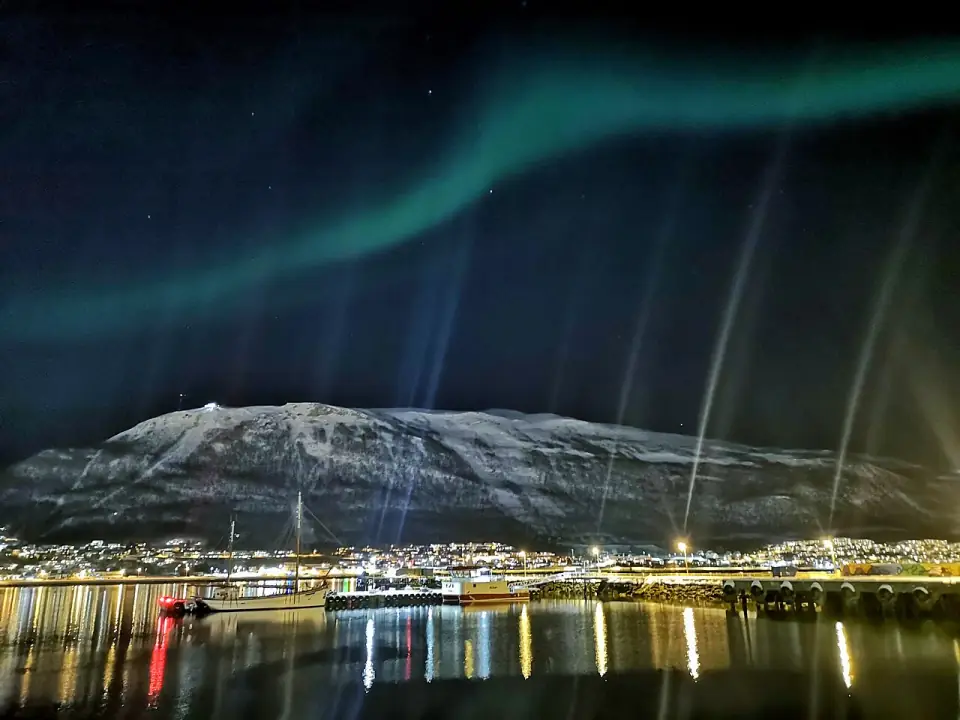
- Under the oval, a low Kp can be a great night. Tromsø's magnetic latitude is about 67°. On a quiet night the oval's edge is already close by, and aurora overhead is common even at Kp 1 or 2.
- Further south, you need much more. NOAA's storm scale puts the visible edge at about 55° geomagnetic latitude at Kp 6 (G2), about 50° at Kp 7 and about 45° at Kp 8. At those latitudes the aurora is usually low on the northern horizon, not overhead.
- The map can mislead. The magnetic pole is not at the geographic pole, so places at the same geographic latitude can sit several degrees apart magnetically. Iceland is a good example: it is magnetically closer to the oval than its position on a map suggests.
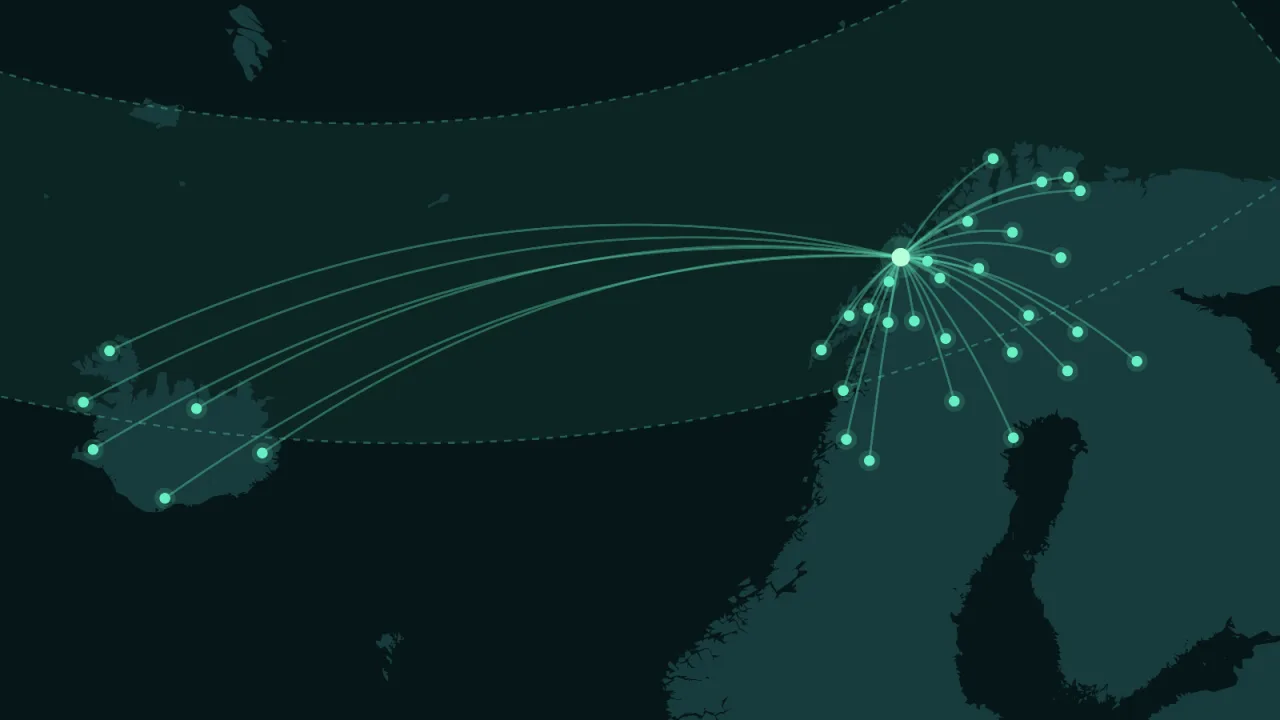
Aurora Atlas works with this directly. Each destination has a magnetic latitude (from the AACGM-v2 coordinate system), and the app translates the planetary Kp into what it means there. The same Kp 2 counts as a good night in Tromsø and as weak further south.
What drives it: the solar wind and Bz
Kp reacts to the solar wind, the stream of particles and magnetic field that flows out from the Sun. Spacecraft such as DSCOVR and ACE measure it at the L1 point, about 1.6 million km upstream of Earth, and this gives a short warning before it arrives.
The single most important quantity in those readings is usually Bz, the north–south component of the interplanetary magnetic field. When Bz points south, it can connect with the Earth's magnetic field and let solar-wind energy into the magnetosphere. This was first proposed by James Dungey in 1961 and is the basis of how we understand geomagnetic storms. Solar wind speed and density matter too: faster, denser wind with a strongly southward Bz is what drives big displays.
The catch is the lead time. NOAA's OVATION aurora model, which uses these solar-wind measurements, gives a forecast of only 30 to 90 minutes. That is why real-time readings are good for "go out now" and poor for "plan my evening".
The equinox effect
Geomagnetic activity tends to be higher around the March and September equinoxes. SWPC lists the seasons around the spring and autumn equinoxes as the best for aurora watching. One widely cited explanation, from Russell and McPherron (1973), is geometric: around the equinoxes the Earth's magnetic field is oriented so that a southward Bz couples into it more often. It is a statistical tendency, not a guarantee for any single night.
What Kp doesn't tell you
Even a perfect Kp forecast leaves out most of what decides your night:
- Clouds. Aurora shines from about 100 km up and above, far above any weather cloud. If the sky is covered, Kp does not matter. On a coast like Tromsø's in winter, this is the deciding factor on many nights.
- Darkness. The aurora is there in daylight too, you just cannot see it. You need the sun well below the horizon. In the far north that rules out the summer months entirely.
- The moon. A bright moon makes the aurora look fainter, though it does not change its real brightness (SWPC says the same). It matters most on quiet nights with a faint glow.
- Light pollution. Streetlights do to a faint aurora what the moon does, only closer.
- Timing. A three-hour index cannot tell you that the display came at 23:10 and was over by 23:40.
So the practical rule is: under the oval, check the sky before you check Kp. Further south, Kp (and Bz) tell you whether there is any chance at all, and then the sky decides.
How Aurora Atlas uses Kp
Aurora Atlas uses Kp, but not on its own:
- Location first. Kp is converted into an effective activity for the destination's magnetic latitude.
- Measured before forecast. For the next few hours, the activity comes from what OVATION measures at the place right now, where it contradicts the Kp forecast. Further ahead, the Kp forecast takes over.
- Clear sky times activity. The score multiplies the two. A clear sky with no aurora scores low, and so does a strong aurora behind thick cloud. Only both together give a high score.
- Darkness and the moon are applied per hour, at each spot.
The result is one score from 0 to 100 for each spot and the best three-hour window. It is not a promise. Aurora forecasting is uncertain, and the honest answer on many nights is "possible, if the sky opens".
Sources
- NOAA SWPC: Planetary K-index
- GFZ Potsdam: Geomagnetic Kp index
- NOAA SWPC: Space weather scales (G1–G5)
- NOAA SWPC: Tips on viewing the aurora
- NOAA SWPC: Aurora
- NOAA SWPC: Aurora 30-minute forecast (OVATION)
- NOAA SWPC: Real-time solar wind
- Dungey, J. W. (1961). Interplanetary magnetic field and the auroral zones. Physical Review Letters 6, 47
- Russell, C. T. and McPherron, R. L. (1973). Semiannual variation of geomagnetic activity. Journal of Geophysical Research 78, 92
- NASA Earth Observatory: Aurora from the International Space Station
Aurora Atlas turns Kp, clouds, darkness and the moon into one score for tonight. It is free on the App Store.