
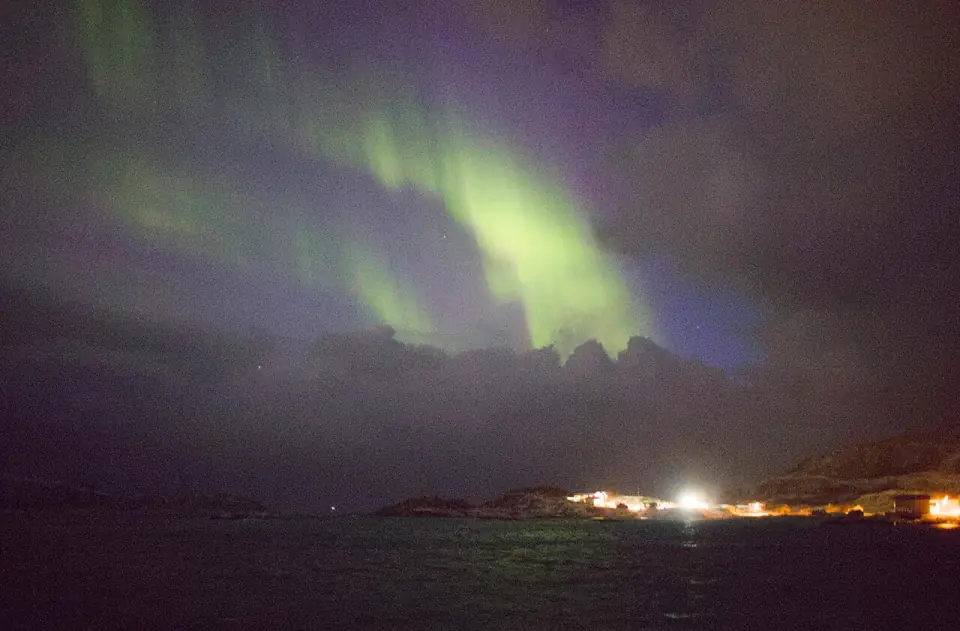
Aurora forecasts are usually about space: the Kp index, the solar wind, the aurora oval. Those matter. But the aurora shines from about 100 km up and higher, and every weather cloud is far below that. If the sky above you is covered, the strongest storm of the year is invisible.
Under the auroral oval, in places like Tromsø, Abisko or Fairbanks, aurora is common. What is not common is a clear sky at the right time and place. On most nights the cloud forecast is the aurora forecast.
One cloud percentage tells you very little
Most weather apps give one number: "cloud cover 70 %". For aurora that number hides almost everything that matters.
Not all clouds are the same
Weather models split clouds by height. MET Norway, Norway's national weather service, gives cloud cover in three layers as well as the total:
- Low cloud, below 2,000 m above the ground: stratus and fog banks. Usually thick and opaque.
- Medium cloud, 2,000 to 5,000 m: often thick enough to hide the aurora, sometimes with thin patches.
- High cloud, above 5,000 m: often thin cirrus. A bright aurora can shine through a high veil that would be hidden completely by low cloud.
So "80 % cloud" can mean a sky full of thin cirrus with the aurora visible through it, or a solid lid of low cloud. Same number, different night.
Not all hours are the same
Clouds move. A night that is "70 % cloudy" on average can have two clear hours, and two clear hours are enough. What you need is the forecast hour by hour, so you can see when the sky is expected to open.
Not all places are the same
Clouds are local. Coastal clouds pile up against mountains, while the valleys behind them stay drier. Around Tromsø, one night the inland valleys towards the Finnish border are open while the coast is overcast, and another night it is the other way round; in Iceland, the other side of the island can be clear when your side is not. Averages hide this: in NASA's satellite record the inland area is only a few percentage points less cloudy than Tromsø over a winter, yet on a given night the two can be completely different. A single figure for a city does not tell you any of this. You need a forecast for each place you could drive to.
On most nights, the cloud forecast is the aurora forecast.
How to read a cloud forecast for aurora
- Look at the hours of darkness only. Clouds at 15:00 do not matter.
- Look for gaps, not averages. A forecast that drops to 20–30 % for a few hours is worth more than one stuck at 50 %.
- Look at the layers if you can. Low cloud is the real enemy. High thin cloud is a nuisance.
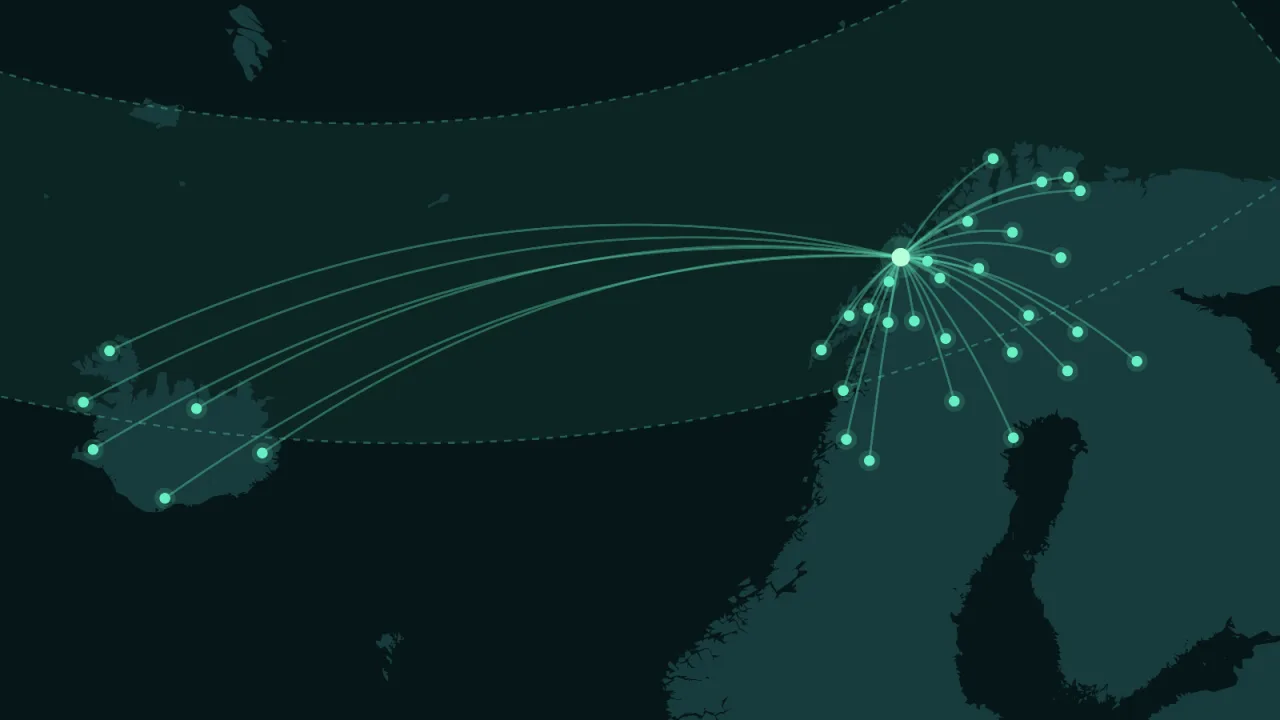
- Compare places. If your base is covered, check the places 30, 60 and 90 minutes away.
- Check again. Forecasts are updated through the day, and cloud is one of the hardest things to forecast precisely. Small gaps often appear that no model predicted, and forecast gaps sometimes close.
- Look up. In the end, the sky above you is the only observation that counts. Stars visible overhead mean you are in business.
Driving to clear skies
Guides in the far north drive because it works. When the coast is under cloud, an hour inland can put you under clear sky. Some practical points:
- Decide early. If the hourly forecast shows the coast covered and a valley clear, leave in time to arrive before the window starts.
- Know your limit. A three-hour drive each way is a long night. Pick a range you are comfortable with, in winter conditions.
- Plan the return. You will be tired, and it will be colder than when you left.
For safety: drive to the conditions, never stop on the road to look at the sky, check road conditions before you leave (in Norway, Statens vegvesen publishes closures), and dress for standing still in the cold.
How Aurora Atlas models clouds
Aurora Atlas was built around this. Here is what it does, and where its limits are.
Every spot has its own hourly forecast. The app reads MET Norway's forecast for each viewing spot, not one forecast per city. The 41 spots around Tromsø each get their own cloud forecast, and so does every spot in the other destinations.
Clear sky is multiplied by aurora activity. The score is not "70 % clear sky plus 30 % aurora". It is clear sky times activity, so both have to be good for the score to be high. A clear sky on a dead-quiet night scores low; so does a strong aurora behind thick cloud. Broken cloud is not treated as all or nothing: at 50 % cloud a spot keeps about 59 % of its aurora points, at 30 % about 77 %, and at 80 % about 30 %. Above 80 % total cloud the score is capped low.
Layers are weighted where the forecast gives them. The model treats low cloud as fully blocking, medium cloud as mostly blocking, and high cloud as partly transparent. When only total cloud is available, the app treats all of it as low cloud, the cautious assumption, so it never scores a night better than the total cloud would suggest. The layer weights are an informed starting point, not measured truth, and they will be checked against real nights as the forecast archive grows.
The best window. For each spot the app finds the best three-hour window inside the hours of darkness. If an earlier window is almost as good (within 5 points), it picks the earlier one, so you are not told to wait until 03:00 for a barely better sky.
Is it worth the drive? Pick your base and how far you will drive, and the app ranks the spots within that range. Long drives cost points after two hours. If a spot just beyond your range is clearly better (at least 10 points), the app says so.
What it cannot do. No forecast sees every gap. The score is an estimate of your chances from public forecast data, not a guarantee, and the sky camera or a look out of the window will always beat it in the moment.
The short version
- The aurora is far above the clouds, so clouds decide most nights under the oval.
- One cloud percentage hides the layer, the hour and the place.
- Look at hourly forecasts during darkness, for several places, and look for gaps.
- Be willing to drive, safely, and decide early.
Sources
- MET Norway: Locationforecast data model (cloud layers)
- Yr (MET Norway and NRK): weather forecasts
- NASA Earth Observatory: Aurora from the International Space Station
- NOAA SWPC: Tips on viewing the aurora
- NOAA SWPC: Aurora
- NASA POWER: climatology API, cloud amount (CERES SYN1deg, 2001–2025)
- Statens vegvesen: Traffic information
Aurora Atlas shows the cloud forecast hour by hour for every spot, and tells you when and where the sky opens. It is free on the App Store.
.jpg)